
REGIONAL ECONOMIC GROWTH
Tracking whether the St. Louis economy is keeping pace nationally and creating the conditions needed for long-term, inclusive prosperity.
DATA RESULTS
St. Louis has the opportunity to grow a stronger regional economy that benefits everyone.
-
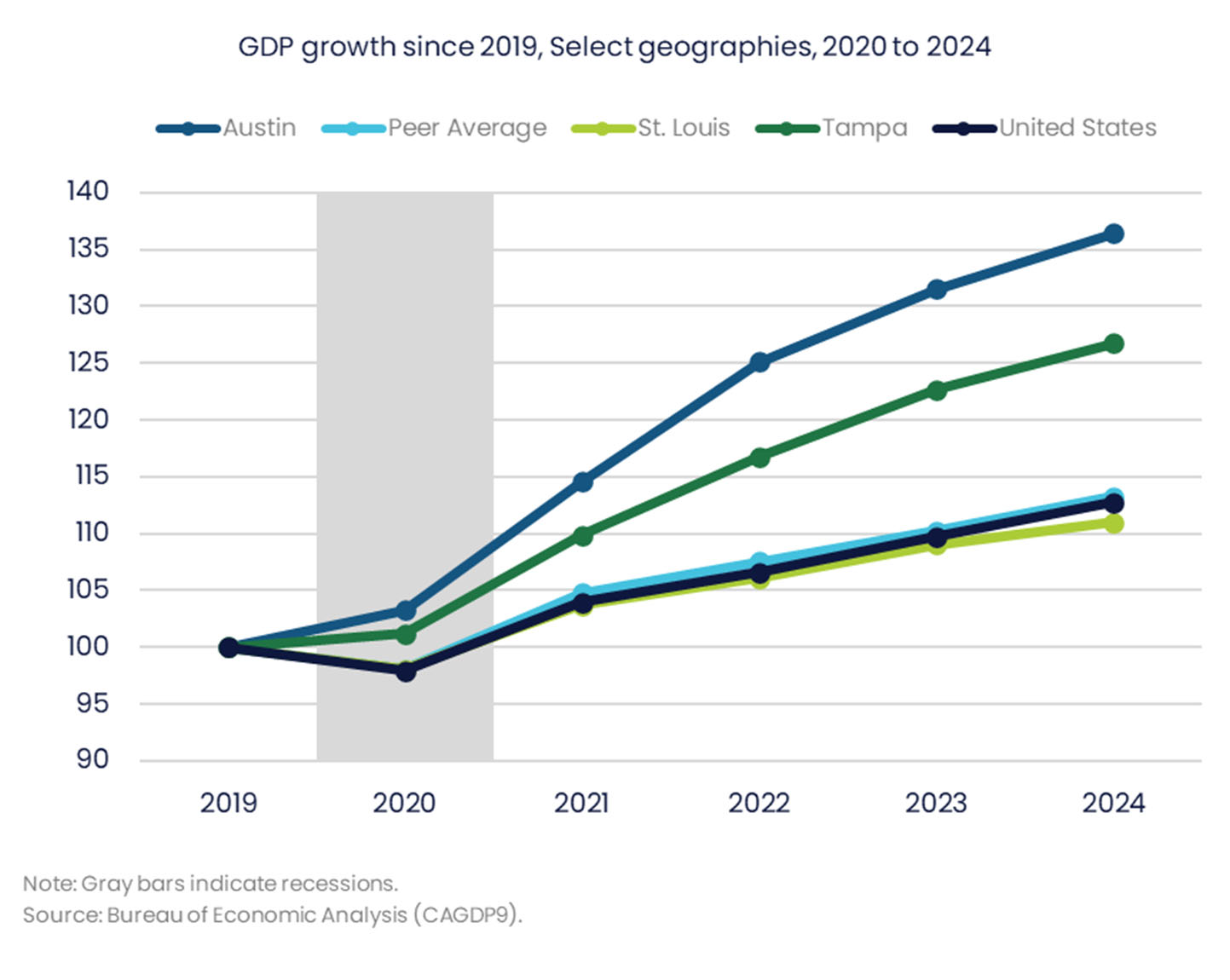
Among the 50 largest metro areas in the country, St. Louis ranks 28th in GDP growth from 2019 to 2024. The region grew 11.0%, compared to the US average of 12.8%.
-
The fastest-growing regions over this period were Austin (36.4%), Nashville (27.4%), Phoenix (27.1%), and Tampa (26.7%). At the other end, New Orleans (1.5%) and Pittsburgh (3.6%) saw very little growth.
-
On GDP per capita growth, St. Louis performs better, ranking 18th. This reflects the fact that while the overall economy did not grow as quickly as the nation’s, St. Louis’s slight population decline meant each person’s share of economic output grew faster than the national average.
WHAT IT IS
Growth Makes Prosperity Possible
Regional Economic Growth reflects whether the St. Louis economy is generating increasing levels of economic activity over time.
This indicator helps answer a fundamental question:
Is the St. Louis regional economy growing — and how does its pace compare to the U.S. economy overall?
Strong regional growth matters because it shapes what is possible:
- The number and type of jobs available
- Levels of public and private investment
- Business formation and expansion
- The region’s ability to attract and retain talent
A growing economy creates the conditions needed for opportunity, innovation, and sustained competitiveness.
METHOD
How We Measure Growth
Regional Economic Growth is measured by tracking:
- Gross Domestic Product (GDP) for the St. Louis metropolitan area
- Change over time relative to national GDP trends
GDP represents the total value of goods and services produced in the region. When businesses sell more, provide more services, and invest in growth, GDP rises. When economic activity slows, GDP growth weakens.
By comparing regional GDP growth to national trends, this indicator shows whether St. Louis is gaining or losing ground in a competitive national economy.
PROGRESS
Progress Means:
- The St. Louis regional economy grows at or above the U.S. average
- Economic growth is sustained over time, not just during short upswings
- The region strengthens its capacity to support jobs, investment, and innovation
- St. Louis becomes more resilient to economic shocks and downturns
- Regional growth signals stability and readiness for long-term investment
Strong regional growth provides the foundation for advancing opportunity and long-term prosperity.
Individual Financial Security
Growth creates possibility. Inclusion makes it durable.
Inclusive prosperity requires both a growing regional economy and widespread participation in that growth.
Growth that is not broadly shared can leave many residents behind and weaken long-term economic performance.
Regions with stronger household stability tend to experience more durable and resilient growth over time. When families can meet basic needs and save modestly, workforce participation strengthens, consumer spending increases, and local economies are better positioned to adapt to change.
That is why IPP tracks Regional Economic Growth alongside individual Financial Security — to understand whether economic gains translate into stability and opportunity for households across the region.